
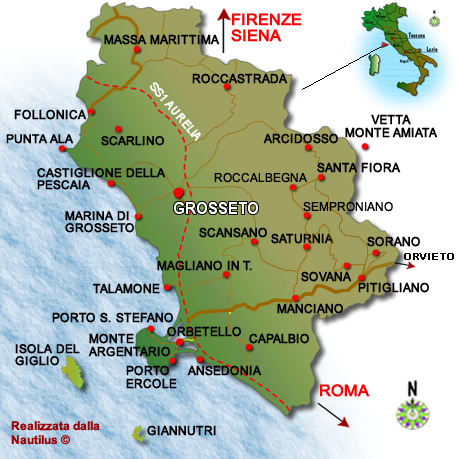
Maremma covers approximately a quarter of Tuscany's territory, between the provinces of Livorno and Grosseto. Dante had already outlined its boundaries in the Divine Comedy, placing them between Cecina and Tarquinia in northern Lazio. What makes Maremma unique, turning it into a perfect microcosm, is the diversity of its landscape. Sea, hills and mountains merge together, lending different colours to the scenery: the blue of the crystal-clear sea around Argentario, the black rocks of Talamone, the yellow of the long beaches of Castiglione della Pescaia, the green hills around Massa Marittima and the brown slopes of Monte Amiata.
Tuscan Maremma is divided into three areas:
Upper Maremma
This area covers much of the province of Livorno and includes the Metalliferous Hills as far as the Gulf of Follonica. Its culture and landscape are closely linked to the area's mineral resources, which have been exploited for centuries, from ancient times to the present day. Here, the Etruscans created an extensive trading network, founding many towns including Gavorrano, Montieri and Monterotondo.
The colours of nature blend with the shades of the metals, creating evocative landscapes dotted with castles, churches, fortresses and watchtowers. The focal point of this magical setting is the town of Massa Marittima, a small yet remarkable medieval town with a magnificent Cathedral and imposing Cassero.

Grosseto Maremma
Or Maremma in the strictest sense. The city of Grosseto, with its Cathedral, the Sienese Keep and the Medici Walls, represents the different influences that have shaped this area. The surroundings of Grosseto are rich in historical and artistic remains, the finest example being the archaeological site of the Etruscan city of Roselle. But Grosseto also means sea and beaches, such as Marina di Grosseto and Principina, pine forests and natural marinas such as Castiglione della Pescaia and Punta Ala. Then there is the inland area, extending to the foothills of Monte Amiata , where undulating hills alternate with dense woodland. The landscape is enriched by villages and castles such as Scansano, famous for Morellino, Campagnatico and Civitella Paganico.
Lower Maremma
This area borders Lazio and is perhaps the most representative part of Maremma as a whole. Here lies the Silver Coast, overlooking the final stretch of the Tuscan coastline and immersed in the Maremma Regional Park, also known as the Uccellina Park. Orbetello, surrounded by the waters of its lagoon, Talamone, with its fortress and historic village, Capalbio and the Tarot Garden, Monte Argentario with its rugged cliffs and crystal-clear waters, together with Porto Ercole and Porto S. Stefano, are just some of the attractions of this part of Maremma. Not to mention the inland area, renowned for its tuff, whose Etruscan roots are still clearly visible, as demonstrated by the towns of Pitigliano, Sorano and Sovana. This part of Maremma is also home to the famous thermal springs of Saturnia, known for their therapeutic properties.
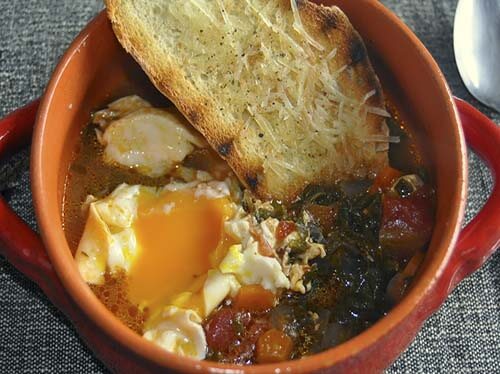
Maremma is undoubtedly a part of Tuscany worth visiting, as it has so much to offer. Not only culture and breathtaking landscapes, but also local specialities and wines to taste. Maremma cuisine consists of simple, traditional dishes prepared with excellent-quality local and seasonal ingredients, to be enjoyed with a good glass of Morellino di Scansano or Bianco di Pitigliano. The most representative dish is acquacotta, which nourished generations of Maremma residents and embodies the art of making the most of what is available. There is no single recipe: each housewife used the seasonal produce from her garden and cheese from her flock. The one ingredient common to all versions is undoubtedly extra-virgin olive oil from the Maremma hills.

Tuscan Maremma is represented in a variety of ways throughout its vast territory, with several noteworthy features: the dense line of pine forests along the coast, made up of classic umbrella pines; the unspoilt nature of the hilly areas, with hornbeams, ferns, alders, elderberries and hazelnut trees; the highly fragrant Mediterranean maquis, characterised by shrubs such as holm oak, strawberry tree, myrtle and mastic, as well as evergreen vegetation and numerous aromatic plants such as rosemary; cultivated fields; and the meadow and pastureland typical of Tuscan and Lazian Maremma. These are environments where nature is still the undisputed queen: in Livorno Maremma to the north and Grosseto Maremma in the centre, where Maremma cattle and Maremma-bred horses have grazed freely or semi-freely for centuries, guided and cared for by the legendary butteri, the shepherds of Maremma and the last cowboys of the old continent, now found mainly in the protected area of the Maremma Regional Natural Park.
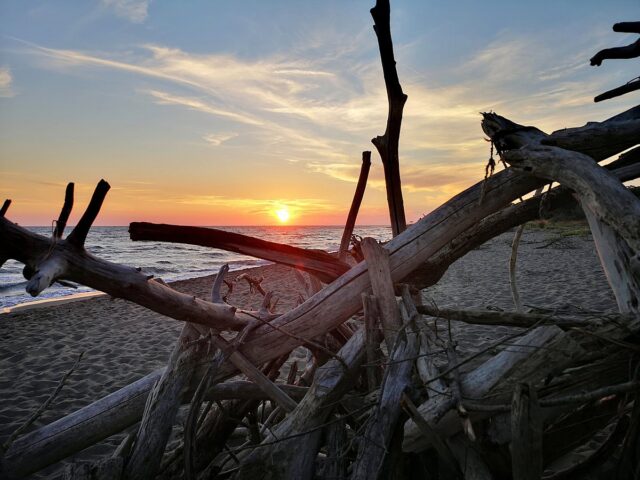
Over the centuries, Maremma has preserved an organic unity, forgotten by governments and administrations, used but never sufficiently appreciated. The people of Maremma have developed a bond of customs, traditions and habits built around a way of life centred on the individual challenge of adverse conditions, on always relying on oneself, never giving up and asking nothing of anyone. The landscapes, geographical profiles and ways of confronting a once-hostile nature may change—sea and mountains, fishing, livestock farming, mining and woodland—but the character of Maremma remains the same. In some areas, it is even more intense because it has remained untouched by contact with the outside world. There are therefore several Maremm as, with different environments, landscapes, people and cultures, but the spirit is one and indivisible: that of breathtaking beauty, still waiting to be discovered.